
What Can You See Driving a Kart Up and Down Shibuya's Hills in Tokyo? A Step-by-Step Guide for First-Timers
What Can You See Driving a Kart Up and Down Shibuya's Hills in Tokyo? A Step-by-Step Guide for First-Timers
The light turns green. The guide's kart ahead of you starts rolling slowly, and your kart falls in behind it. As the road begins to climb, half your view fills with sky. Once you reach the top, the city opens up below you, as if it were spilling down toward your feet. When you drive a kart through Tokyo's Shibuya, each hill you crest reveals a new view. You won't find these views on flat roads.
For first-time visitors to Japan, the biggest worry is often not knowing what will happen. Where do you go? Who explains things to you? What will you see on the hills, and what should you watch out for? This article uses Tokyo's Shibuya area as its setting and walks you through everything in order, from booking to the end of your drive.
The place name Shibuya contains the kanji 谷 (tani), which means "valley." True to its name, the area around Shibuya Station sits low, and many uphill and downhill roads stretch out from it into the surrounding neighborhoods. When you first walk around Shibuya, you might be surprised: "Wait, there are way more hills than I expected!"
The view looking down from the top of a hill is nice in any city. In Shibuya, what you look down on are building facades, huge billboards, and waves of people flowing across the crosswalks. It's simply great. Hills only show their views to people who climb them, and you get to take in those views from the seat of a kart. That's what makes it so much fun!
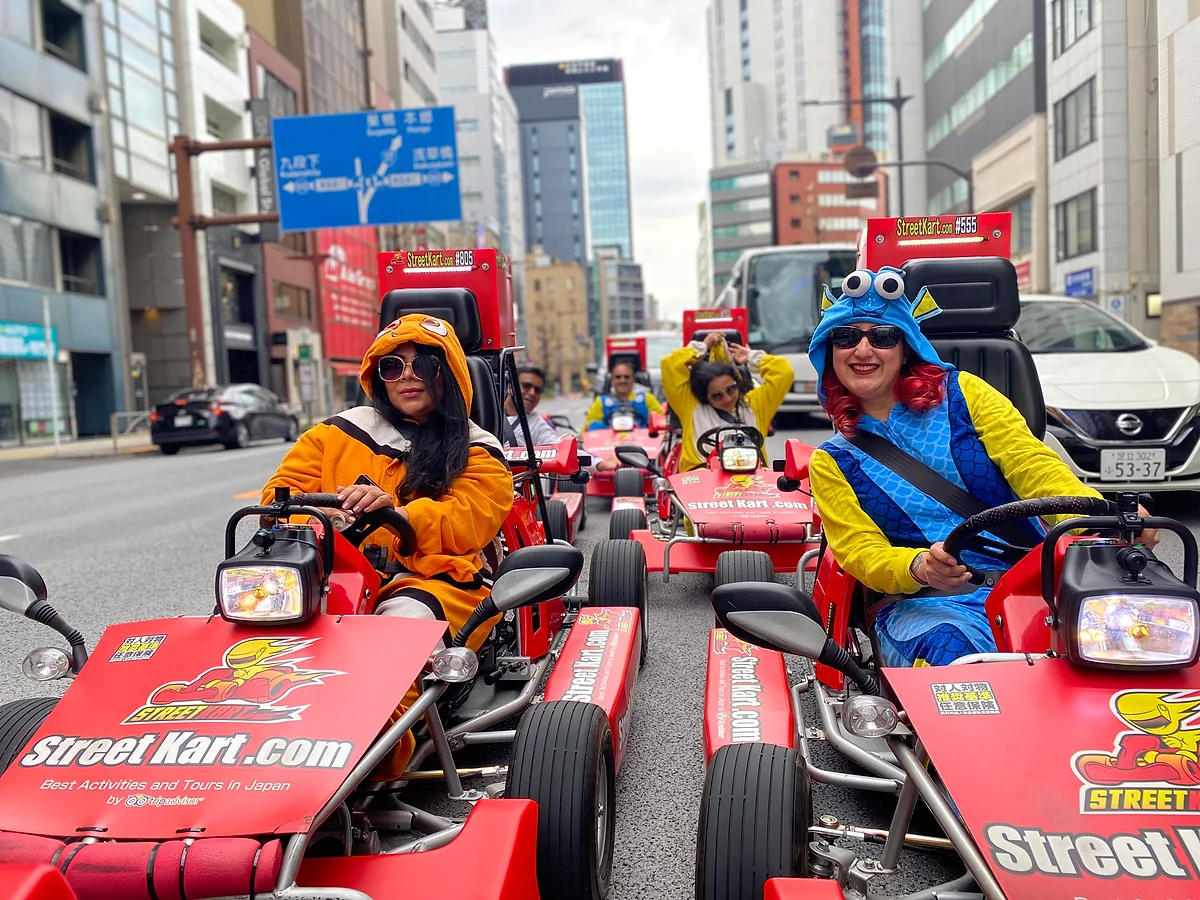
One important point first. Street Kart runs its street karts as guided tours, with a guide driving at the front. You follow the guide along a set course. On the day, the guide decides which roads you take and in what order. You don't have to find your own way. For first-timers who don't know Tokyo's roads, I think that's actually a big plus.
Step 1: Choose Which Location to Start From
Street Kart has 9 locations nationwide (7 in Tokyo, 1 in Osaka, and 1 in Okinawa). Of the 7 Tokyo locations, the Shibuya shop and Shibuya Annex are in almost the same place, and so are Akihabara No. 1 and No. 2. So it doesn't mean you can choose from 7 separate neighborhoods in Tokyo. Keep that in mind from the start.
The hill views in this article mainly come from tours that start at the Shibuya shop or Shibuya Annex. Both are in Maruyamacho, Shibuya Ward. The course and the scenery depend on the location. So if you've decided you want to drive through Shibuya's hilly streets, a Shibuya location is the easiest place to start.
Tours from the Shibuya locations include the Shibuya Scramble Crossing, the area around Shibuya Station, Harajuku's Takeshita Street, and Omotesando. The areas around Meiji Jingu Shrine, Yoyogi Park, and NHK Hall are also listed. Just reading the list is exciting.
Step 2: Make a Reservation (Book Early for Weekends)
You can book via Facebook, LINE, or email (booking@streetkart.com). The key is to get in touch early, as soon as you know which day you want to go, even if the rest of your trip isn't settled yet. Weekends fill up quickly, so if you want to drive on a Saturday or Sunday, booking early is especially recommended.
For reference, as of November 2023, the combined numbers for all locations were over 150,000 tours run, over 1.34 million customers, over 20,000 reviews, an average rating of 4.9 out of 5.0, and over 250 vehicles.
Prices vary by season and time of day. Please check the official website (kart.st) for the latest information. Departure time slots and tour lengths also vary by location and tour, so check those on the official website too. That way you won't be rushing on the day.
You might also be worried about language. On tour days, guidance is basically in English. Guidance in Japanese or other languages depends on the staff that day, so it can't be guaranteed. If you need explanations in a language other than English, try asking in advance through the official website. The official website is available in 22 languages.
Even if you don't speak Japanese, there are plenty of moments when smiles and gestures are enough! But when it comes to driving instructions, never pretend to understand something you don't. Asking again is nothing to be embarrassed about.
Step 3: Check Your Driver's License
Since you'll be driving on Japanese roads, you need a valid driver's license. Which licenses from which countries are accepted, and whether you need an International Driving Permit, depends on your situation. Listing only some of the conditions could cause confusion, so this article doesn't go into the details. Be sure to check the official website for what you need in your case.
It's a good idea to check this before you pack. If you arrive in Japan and realize you left your license at home, you can't just pop back and get it. Take a moment to confirm this before you leave.
Step 4: Getting to the Shop (Even the Walk Is Hilly)
There's no parking at the shops. Please use trains or other public transportation.
The nearest station to the Shibuya locations is Shinsen Station, a 5-minute walk away. From Shibuya Station, it's a 10-minute walk. Shibuya Station is served by JR, Tokyo Metro, Tokyu, and the Keio Inokashira Line.
If you walk from Shibuya Station, this is where you'll first feel the hills in your body. As you move away from the crowds around the station, the road gently rises and falls. Some climbs will leave you a little out of breath. Remember these ups and downs you felt on foot. Later, when you're in the kart, you'll realize, "That same feeling I had walking uphill is now happening at eye level!" It's a really fun moment.
Shibuya Station is huge, so transferring or finding the right exit may take longer than you expect. Factor that in and give yourself plenty of time.
Step 5: Once You Arrive, Listen Carefully to the Briefing
When you arrive, follow the staff's instructions for check-in and preparation. This is where they explain how to drive. The briefing is basically in English.
The karts are single-seaters. Two people can't ride in one kart. Everyone in your group drives their own kart and follows the guide. You're the one behind the wheel, and that feeling is fantastic. For details on how groups are organized and other tour specifics, check the official website.
This tour isn't a race. It's not about passing the kart in front of you or comparing speeds. It's about following the guide and taking in the city as you drive. When the briefing covers following distance and what the signals mean, pay extra attention. On hills, following distance becomes very important (more on that later).
The kart seats sit low, and there's no roof. So the scenery you'd normally see through a car window hits you directly. Buildings tower overhead, and the buses and trucks beside you look surprisingly huge. Engine noise, the electronic beeps of traffic signals, the chatter of people waiting at intersections, music drifting out of a shop somewhere. The wind brushes your cheeks, and you can feel the road's small vibrations through the steering wheel. It all reaches you directly.
If you love music, you'll probably notice the rhythm. Stop at a light, start moving, stop again. That repetition settles into your body like a slow beat. The streets of Tokyo flow by like a song.
Add hills to this, and the way you see things changes completely.
Step 6: How Does the View Change on a Hill? Three Scenes: Uphill, the Top, and Downhill
On flat roads, what you mostly see is the kart in front of you and the road beyond it. But when you start going uphill, your low seat tilts your line of sight sharply upward. You see the upper halves of the buildings lining the top of the hill, and the sky beyond them. On a clear day, blue sky fills your view. On a cloudy day, it's a pale, whitish gray.
Through a designer's eyes, the composition at this moment is really interesting. The lines of the buildings on both sides of the road converge smoothly toward the top of the hill. It becomes what artists call one-point perspective, and you feel as if you're being pulled into the center of the picture. It's something I really want you to experience at least once.
Just before you reach the top, the road ahead can briefly disappear from view. Then, the moment you pass the top, the city opens up below you. The intersection at the bottom of the hill, the signs on the buildings across the way, the cars and people coming and going. A moment ago you could only see sky, and suddenly all of this rushes into view. This switch from closed to open is the real thrill of driving through a hilly city!
Going downhill, your gaze naturally drops to the road ahead. The streetscape in front of you grows bigger and bigger as the kart moves forward, as if it were coming toward you. Where there's a big intersection at the bottom of a hill, you may even see the crowds crossing the street from above.
That said, don't get so caught up in the hill views that you lose focus. We'll cover this properly in the next section.
Four Things to Watch Out for on Hills
Places where the view changes are also places where you need to drive carefully. Set the fun stuff aside for a moment and read this section calmly.
First, keep your distance from the kart in front. Karts pick up speed easily going downhill, and the kart ahead may slow down going uphill. In both cases, keep the following distance you were told about in the briefing. Getting too close to the kart in front because you're busy looking at the view is the one thing to avoid on hills.
Second, you can't see past the top of the hill. Just before the crest, you can't tell what the road looks like on the other side. Watch the kart ahead and the guide closely, and don't rush.
Third, smartphones. When the view is beautiful, you'll naturally want to take pictures. I completely understand. But holding a smartphone while driving is dangerous. Take your photos before and after the drive. While driving, focus on taking in the scenery with your eyes and your body. Your memories will be far more vivid when you look back on them later.
Fourth, which side of the road you drive on. In Japan, cars drive on the left. If you come from a country that drives on the right, your body may try to steer toward the wrong side when you turn at intersections. Stay behind the guide and make a point of following the same lane.
The Views Along the Shibuya Course
Now let's look at the places included in tours from the Shibuya locations, seen through the lens of a hilly city.
The bottom of the Shibuya "valley" is the area around Shibuya Station and the Scramble Crossing. Tall buildings like Shibuya Hikarie, Shibuya Scramble Square, and Shibuya Stream surround the valley floor. Looking up from a low kart seat, you can feel how deep this valley is. As you head down toward the valley floor, you may see crowds flowing across the intersection from above, as described in Step 6.
Depending on the tour, Dogenzaka may also be on the course. It's a road with zaka (slope) right in its name. Uphill, the sky opens up, and when you crest the top, the city spreads out before you. You'll experience that switch at the top of one of Shibuya's hills.
Omotesando, Harajuku, and the areas around Meiji Jingu Shrine and Yoyogi Park are also on the course, but which hills you go up and down on the way there is up to the guide on the day.
The same place looks different depending on the season, the weather, and the time of day. No one can promise that it will look a certain way at a certain time. That's exactly why you should enjoy the face of Tokyo that you can only see in that moment. There's a Shibuya for days when the sky is high, and a Shibuya for days when the clouds hang low. Both are a good Shibuya.
After Your Drive: See the Hilly City Again, on Foot and from Above
After the tour, I recommend getting out of the kart and seeing the same city from a different angle. The places below are not on the tour course. They're near the shop, so you can stop by before or after your tour.
First, Dogenzaka Ramen Yokocho, an 8-minute walk from the shop. With zaka in its name, it's a fitting spot in hilly Shibuya. Steaming ramen hits the spot after a drive! Shibuya Center Gai and Spain-zaka, a 12-minute walk away, are packed with shops and restaurants, and you can feel the city's energy as you walk up and down the slopes.
If you want to double-check the hilly city you just drove, Shibuya Scramble Square, a 10-minute walk from the shop, is perfect. This 230-meter building has an observation deck called Shibuya Sky. Look down over Shibuya and try to spot the roads you drove up and down in your kart. It's a lot of fun.
A tip for anyone who loves night photography: when shooting night views through glass, get your lens as close to the glass as possible so the indoor lights don't reflect. You'll get much cleaner shots.
If you have the time and energy, a walk along the forested approach at Meiji Jingu Shrine, a 20-minute walk from the shop, is also a nice idea. You drove around the area on the tour, and now you can walk it slowly on your own feet. The same Tokyo will look different again.
Your First Step: Pick the Day You Want to Go
Looking back at everything we've covered, what you need to do is simple. Choose the location you want to drive from. Book via Facebook, LINE, or email. Check the driver's license requirements on the official website. Take the train to the shop. After that, all you have to do is listen carefully to the briefing and follow the guide as you set off.
As you climb Shibuya's hills, the sky opens up in front of you. When you pass the top, the city suddenly spreads out below. As this repeats, you come to understand the meaning of the name "valley" with your body, not from an explanation. It's a truly wonderful experience.
Weekends fill up fast, so get in touch early once your travel dates are set. Prices vary by season and time of day, so check the official website (kart.st) for the latest prices, departure times, and requirements. Tokyo's hilly streets are waiting for you to take the wheel!
This article was originally written in Japanese and translated using AI. Some expressions may read unnaturally, and we appreciate your understanding. For the most accurate and up-to-date information, please refer to the official site at kart.st.
Street Kart is not affiliated with Nintendo or the Mario Kart series in any way. We do not provide costumes of Nintendo characters, and such costumes may not be worn during tours even if brought by participants.