
On Your Second Tokyo Street Kart Ride, Enjoy the Faces of the People Driving in Your Line
On Your Second Tokyo Street Kart Ride, Enjoy the Faces of the People Driving in Your Line
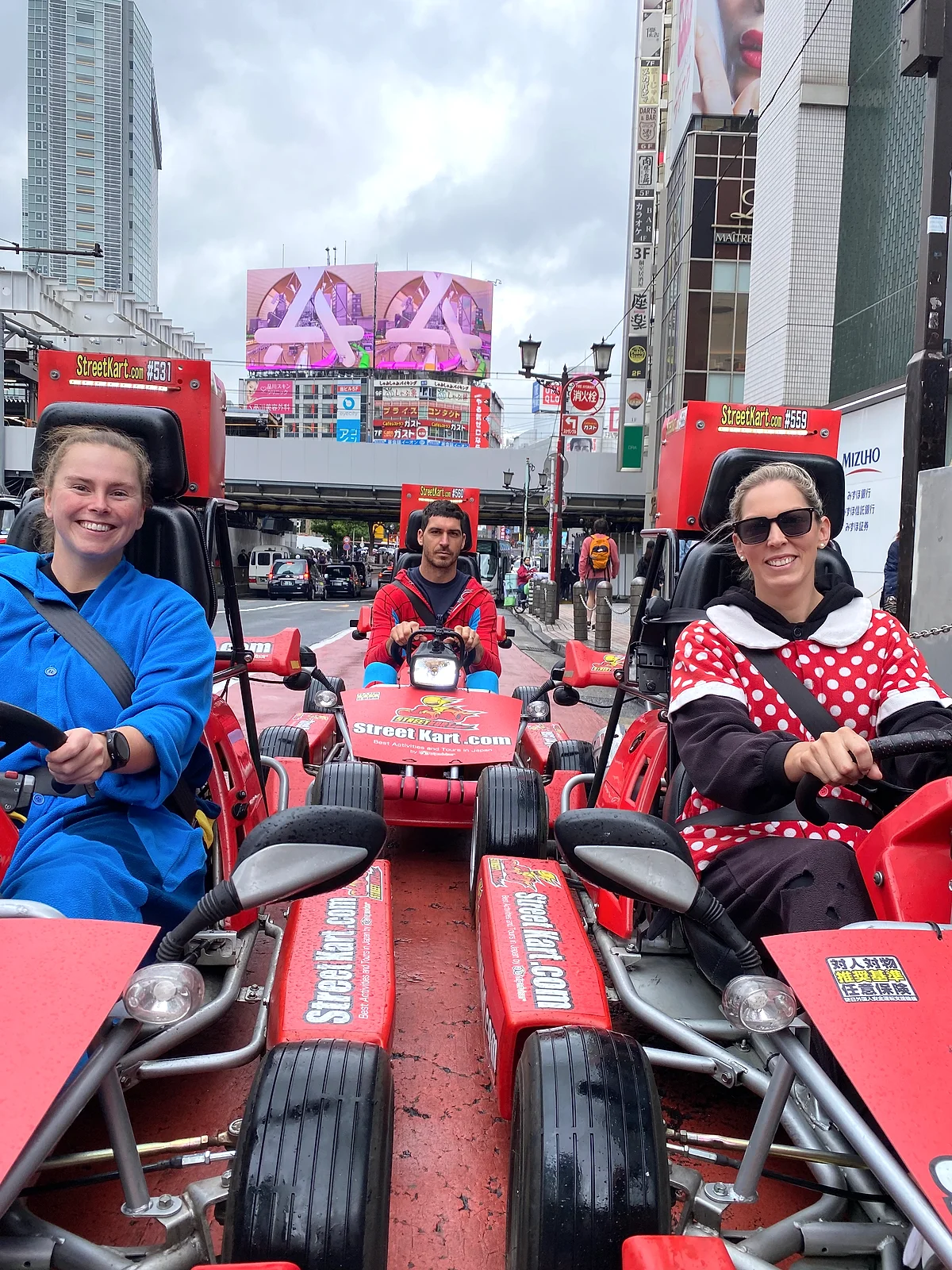
The light turns green. The guide at the front raises a hand, and the line of karts slowly starts to move. Some of the engines rumbling behind you might belong to people you met for the first time at the shop just a few minutes ago.
Be honest: the first time, you didn't have room to notice any of that! You were busy with the feel of the steering wheel, the back of the guide in front of you, the traffic lights, and Japan's left-hand traffic. Your mind was so full of what was right in front of you that the ride was over before you knew it. If that sounds like you, you're exactly who I'd recommend a second ride to. On your second time, even the strangers driving in your line start to look like part of Tokyo's scenery.
I'm writing this for people who are traveling in Japan and have already done one street kart ride. Maybe you're wondering whether to go again, and if so, which location to pick. I'll go through the basics in order, so it should make sense even if this is your first trip to Japan.
Where your eyes go on the first ride and on the second
On your first ride, your eyes stay locked on what's ahead. You watch the guide, check the gap to the kart in front, then look at the lights again. That's all you can manage. And on a first ride, that's fine.
The second time is different. Your body already remembers how to get in and what it feels like to pull away. That gives you a little room to spare. What you do with it is up to you. You could look at the building signs, or at the sky. But what I really want you to look at is the faces of the other people on your tour.
You glance to the side while waiting at a light, and the person in the next kart is looking at you and smiling. Even if you don't share a language, that smile says it all: "I know, right? This is so much fun!" That moment makes me so happy! You can't talk while you're driving, and yet by the end of the ride, you've somehow become a little bit friends.
Speaking as a DJ, a tour line is a bit like a dance floor. At first, everyone is just focused on their own steps. But as the track goes on, people start to notice the moves around them, and the whole floor comes together in one rhythm. On your first ride, you were someone who had just stepped onto that floor. On your second, you can dance while feeling the rhythm around you. Keep a steady gap to the kart in front, and drive calmly so the person behind you can see clearly. Just doing that, you'll feel the mood of the whole line soften.
Let me explain one thing about how things work in Japan. Japanese people often seem reserved when meeting someone for the first time. Even when your eyes meet, they may just give a small nod. That doesn't mean they're cold. They read the other person and close the distance little by little. That's the Japanese way. In Brazil, a first meeting can start with a hug, but in Japan it starts with a small bow. Both are ways of greeting someone with care. On your second ride, take your time and enjoy those small changes you couldn't notice the first time.
Lining up with people you don't know
So how does the tour work? Let's go over the basics.
Street Kart is a guided tour: a guide drives at the front, and participants follow behind. Each location has a set route, and the guide leads the way. For details on how groups are put together for each tour, please check the official website.
If there are strangers in your line, I hope that on your second ride you'll treat that as part of the fun. Simply having other people to drive with turns the tour into a chance to meet someone on your trip.
On the day, guidance is basically given in English. Whether guidance is available in Japanese or other languages depends on the staff that day, so I can't promise anything. If language is a concern, check the official website beforehand. Even if your English isn't great, start by watching the guide's hand signals closely. If you don't understand something, just ask. Ask with a smile, and people will understand what you mean!
Second-timers have one more job. If the first-timer next to you looks nervous, tell them, "Just follow the guide and you'll be fine." Even if you can't speak Japanese and your English is shaky, a thumbs-up gets the message across. I believe an atmosphere where everyone can have fun, whatever their nationality, starts with small words like that.
A word about photos, too. I think it's best to put your phone away while driving and focus on the road. You can take pictures before you set off or after the ride. When the ride is over, take a photo lined up with the people who were strangers just a little while ago. That's sure to be a photo you'll look back on again and again from this trip.
Driver's license requirements vary by country and license type. Make sure to check the Street Kart official website to see whether your license qualifies. Just because you could ride the first time doesn't mean a new friend you invite meets the same requirements. When you invite someone, the safest thing is to look at the official website's guidance together. The official website is available in 22 languages, so look together for a page in their language. As of November 2023, the total number of customers across all locations was over 1.34 million, with an average rating of 4.9 out of 5. It could also be good to show them figures like these.
There's one more thing to keep in mind that's specific to Japan's cities. The shops don't have parking. Get there by train or other public transportation. A transit app should make even an unfamiliar line easy to manage. Also, keep in mind that in Japan, arriving a little before the meeting time and waiting is the norm. If you get there early, you'll be able to start off on a good note, even in a group of strangers.
Try a different location for your second ride
If you're still choosing where to go, here's what I want you to know: the scenery you drive through is completely different depending on the location. Street Kart has 9 locations across Japan: 7 in Tokyo, 1 in Osaka, and 1 in Okinawa.
That said, the 7 Tokyo locations aren't spread across 7 separate areas. Akihabara's first and second shops are in almost the same place, and so are Shibuya and Shibuya Annex. The number of locations isn't the same as the number of different sceneries you can drive through. Keep that in mind.
Driving again from the same location as your first ride is a fine choice too. But for a second ride, I also recommend choosing different scenery. When the scenery changes, strangely enough, even the sense of distance with the people you're driving with changes.
If you can't decide, one approach is to pick the "opposite scenery" from your first location. If your first ride was through a downtown packed with buildings, go to the waterfront by the bay for your second. If your first was the waterfront, go to Shibuya with its heavy crowds, or Akihabara with its stacked signs. In music terms, it's like slipping a slow song in after an up-tempo one. It gives your whole trip some contrast, and it gives you something to talk about with new friends: "Last time I rode from a different location."
Shibuya: Lining up with strangers in the middle of the crowds
Spots listed along the routes from the Shibuya and Shibuya Annex shops include the Shibuya Scramble Crossing, Takeshita Street in Harajuku, and Omotesando with its zelkova trees. The Scramble Crossing is a symbol of Shibuya, where huge crowds cross from every direction at once.
In music terms, driving here feels like being in the middle of the dance floor. The sounds of the city surge in from all sides, and you feel as one with the people in the karts ahead and behind, all riding the same beat. If you love a party, you'll love this vibe. When you turn onto Omotesando, the air suddenly calms down. It's a street lined with green trees and glass buildings, and the heat from a moment ago turns into a pleasant afterglow.
The shops are about a 5-minute walk from Shinsen Station on the Keio Inokashira Line, and about a 10-minute walk from Shibuya Station. Shibuya Station has many exits and it's easy to get lost, so give yourself plenty of time.
Tokyo Bay and Shinagawa: The bayside breeze and Tokyo Tower in the distance
Spots listed along the route from the Tokyo Bay shop (Shinkiba) include Rainbow Bridge, Odaiba, and Tokyo Tower. Rainbow Bridge is a 798-meter suspension bridge spanning Tokyo Bay, lit up in seven colors at night. Tokyo Tower is a 333-meter red-and-white steel tower completed in 1958, a symbol of Tokyo in the Showa era.
The rhythm here is totally different from Shibuya. Instead of weaving through canyons of buildings, your view suddenly opens up toward the sea. Like bossa nova, it's scenery that lifts your mood slowly but surely. Focus on driving while you're on the road, and when the ride is over, try asking someone you just met, "Did you see that view?"
Spots listed along the route from the Shinagawa shop also include Rainbow Bridge and distant views of Tokyo Tower, the high-rises around Shinagawa Station, and the Shibaura and Tamachi waterfront area. The scenery feels like going back and forth between the city and the sea.
The Tokyo Bay shop is an 8-minute walk from Shinkiba Station. The Shinagawa shop is a 3-minute walk from Kita-Shinagawa Station on the Keikyu Main Line, and about a 10-minute walk from Shinagawa Station. Whether there are tours running at times when you can see the nighttime illuminations depends on the location and season, so check the official website.
Akihabara: A red-brick station building and a town of stacked signs
Spots listed along the routes from the Akihabara shops include the Marunouchi Building of Tokyo Station, Ginza, and Akihabara Electric Town. Tokyo Station's Marunouchi Building is a red-brick building that opened in 1914, and its restoration was completed in 2012. In Ginza, the landmark is the Wako clock tower standing at the 4-chome intersection.
The signs of Akihabara Electric Town are a true flood of color. Looking at them with a graphic designer's eye, primary colors pile on top of each other as much as they possibly can, and yet somehow they come together as one. That's what makes it so fascinating. Historic red brick and a town full of loud signs: if you experience that huge contrast with people you don't know, I think you'll find you have no end of things to talk about after the ride.
After the ride, and on to your next booking
The tour ends and you leave the shop. It would be a shame to just part ways with the people who were driving in your line a moment ago. Try asking, "What are you doing after this?"
Near the Shibuya shops, there's Shibuya Niku Yokocho about a 10-minute walk away, and Dogenzaka Ramen Yokocho about an 8-minute walk away. Near the Shinagawa shop, you could stop by Shinagawa Shrine, a 5-minute walk away, and then walk along the canals at Tennozu Isle, about 20 minutes on foot. From the Tokyo Bay shop, Odaiba is about 10 minutes by car, and there's a café and restaurant called CASICA at Shinkiba Station. Near the Akihabara shops, try heading out to Kanda Myojin, about a 10-minute walk away.
There are also some Japanese customs that are useful to know when eating with people you've just met. Many people say "itadakimasu" before eating. Some restaurants can't split the bill per person, so in that case it's common for one person to pay for everyone and then split it evenly afterward, which is called "warikan." Not starting to drink before the toast is also important manners in Japan. Just knowing these small customs makes time with new acquaintances much easier.
Even if you can't speak Japanese, don't worry too much. With a translation app and a smile, you can get most things across. In Brazil, people will sit down at the same table with strangers right away, but in Japan it takes a little courage to make that first move. Still, if it's someone who was just inside the same roar of engines with you, you've probably already used up about half of that courage.
If you're thinking about booking a second ride, the key is to act early. Weekends tend to fill up, so once your dates are set, I recommend booking soon. Bookings are accepted via Facebook, LINE, and email (booking@streetkart.com). For the latest information, such as each location's routes and how the day goes, check the Street Kart official website.
On your first ride, you were caught up in yourself driving through Tokyo. On your second, you drive through Tokyo together with whoever is next to you. It's the same city, but the view will surely be different. Before you set off, before you get into your kart, try smiling at the people on your tour. And when the ride is over, look at each other and smile once more. When you share that smile, your second tour will have become a memory unlike your first.
This article was originally written in Japanese and translated using AI. Some expressions may read unnaturally, and we appreciate your understanding. For the most accurate and up-to-date information, please refer to the official site at kart.st.
Street Kart is not affiliated with Nintendo or the Mario Kart series in any way. We do not provide costumes of Nintendo characters, and such costumes may not be worn during tours even if brought by participants.