
Meeting Up with an Old Friend in Tokyo: How Little Can You Plan? What to Decide Before Reuniting on a Street Kart Tour
Meeting Up with an Old Friend in Tokyo: How Little Can You Plan? What to Decide Before Reuniting on a Street Kart Tour
You say "It's been so long!" and then, for a moment, nothing else comes out. The longer it's been since you last saw someone, the more awkward the first few minutes tend to feel. That's fine. You're just happy to see each other.
But maybe your friend has never been to Tokyo, and you haven't decided where to go yet. Once you start looking up restaurants, mapping out routes, and coming up with a backup plan for rain, you can wear yourself out before you even meet. This article comes at it from the other direction: how much of the planning can you skip, and what can't you skip? If you put a Tokyo street kart tour in the middle of the day, you end up with far fewer decisions to make.
Only Three Things Can't Be Skipped: Booking, Driver's License, and Transportation
First, let's get the essentials out of the way. Once these are sorted, the rest is easy.
The first is booking. In Japan, popular experiences and restaurants usually expect you to book ahead rather than just show up on the day. Street kart tours work the same way. Weekends fill up fast, so book as soon as you've settled on a date. Bookings are taken through Facebook, LINE, and email, and the contact details are on the Street Kart official website. You pay the full amount in advance by credit card through PayPal, and you don't need a PayPal account. Several people can also pay separately using the same payment link. Paying in a currency other than yen incurs PayPal fees, so let your friend know if they're coming from overseas. Cancellation is free up to 7 days before your tour. Go over the cancellation policy together before booking, including what happens after that point, so neither of you is caught off guard. In some countries, "Let's just meet up on the day and see!" works fine for a reunion, and that can be fun. In Tokyo, though, the small step of booking ahead buys you peace of mind on the day. When you're in Tokyo, go with Tokyo's rhythm. That's part of the fun of traveling, too.
The second is checking driver's licenses. On a street kart tour, you drive the kart yourself. There are license requirements for driving, and what you need depends on the type of license you hold. Whatever your license, one thing matters: bring the original paper document on the day. Digital licenses aren't accepted, and you can't join without the original. The full requirements are on the Street Kart official website, so be sure to check them. For example, if you're using an International Driving Permit, it must be a paper booklet issued under the 1949 Geneva Convention. These are issued by an automobile association or government agency in the holder's home country, so ask your friend to get one while preparing for the trip. Licenses from Switzerland, Germany, France, Belgium, Monaco, and Taiwan need an official Japanese translation along with the original license. Don't forget to bring your passport for ID, too. And check your friend's documents as well as your own. You really don't want your friend to be the one who can't drive on your reunion day. Send them the link in a message before you meet: "Check the license requirements!" That alone takes care of most of this step.
The third is transportation. The shops have no parking, so take the train, subway, or other public transportation. A map app will handle the transfers, so there's no need to spend time agonizing over this.
Apart from these three, clothing, rain, and luggage just need a quick look at the official website when you book. Closed-toe shoes such as sneakers are recommended, and the site asks you to avoid open-toe sandals, heels, skirts, and dresses. It also advises against expensive clothing, so don't overdress just because it's a reunion. In summer, bring a hat, sunglasses, and sunscreen. As for rain, tours go ahead as planned in light to moderate rain, and raincoats are provided free of charge. In heavy rain or typhoons, tours are canceled, and you can choose between a shortened tour with the difference refunded, moving to another date, or canceling for a full refund. For luggage, the shops have lockers for small items, but they aren't suited to large items like suitcases. The karts only fit a smallish bag, so ask your friend to pack light for the day.
Choosing a Shop Means Choosing a Meeting Spot
Next, decide which shop to go to. This is the trick that makes your reunion day much easier, because picking a shop settles both "where do we meet?" and "what do we see?" in one go.
There's one thing worth telling anyone using a big Japanese station for the first time: Tokyo's major stations have a huge number of exits. "Let's meet at the station" often means missing each other. You'd rather not spend your reunion wandering around the same station looking for each other. That's why it's a good idea to meet at the shop itself or at an easy-to-spot landmark nearby.
There are seven shops in Tokyo. That said, Akihabara 1 and 2 are practically in the same spot, as are Shibuya and Shibuya Annex. Here we'll cover the shops in Akihabara, Shibuya, Shinagawa, and Tokyo Bay (Shinkiba). Some shops aren't covered here, so see the official website (kart.st) for the full list.
The Shinagawa shop is a 10-minute walk from Shinagawa Station, where the Shinkansen stops, or 3 minutes from Kita-Shinagawa Station on the Keikyu Main Line. If your friend is coming to Tokyo by Shinkansen, it's a very convenient location. If you have some time before your tour, stop by Shinagawa Shrine, 5 minutes away on foot. A photo in front of the torii gate at the stone steps makes a perfect souvenir of your reunion. The route's highlights are waterfront views like the Rainbow Bridge and Tokyo Tower in the distance.
The Akihabara shop is right next to the Electric Town. The route includes the red-brick building of Tokyo Station and the streets of Ginza. A station building with more than 100 years of history, and an electronics district packed with signs: the fun of this area is getting both at once. If your friend loves anime or manga, just walking around the shop will keep the conversation going nonstop.
The Shibuya and Shibuya Annex shops are a 10-minute walk from Shibuya Station, or 5 minutes from Shinsen Station on the Keio Inokashira Line. The Hachiko statue, a famous meeting spot, is a 10-minute walk from the shop. The area around it is always crowded, though, so you'll find each other more easily if you get as specific as "in front of the Hachiko statue, by the planters." The route passes the zelkova-lined Omotesando avenue and the Harajuku area.
The Tokyo Bay shop is an 8-minute walk from Shinkiba Station, served by the JR Keiyo Line, the Tokyo Metro Yurakucho Line, and the Rinkai Line. The route includes the Rainbow Bridge and Odaiba, so you drive with the open views of Tokyo Bay all around you. The shop notes that evening tours also let you enjoy the night views. The Rainbow Bridge lights up in seven colors at night, so if you want to end your reunion day with a night view, consider an evening slot. If your friend loves a sea breeze, they'll probably love this one.
Each shop has its own courses, so once you've picked a shop and a course, "what to see" is basically settled. That one choice replaces the work of putting together a sightseeing list. Check the official website for course details at each shop.
The easiest way to handle all this is to put it in a single message: "I booked this shop for this date. Here's the page with the license requirements. There's no parking, so come by train. Let's meet at the XX exit of XX Station." Send that, and your friend will know at a glance what to do. The official website is available in 22 languages, so it's a nice touch to send the license requirements page in your friend's language. When you haven't seen someone in years, short and specific is easier for both of you than a long explanation.
While You're Driving, You Don't Have to Think About Anything
Some people may feel uneasy about not knowing what will happen on the day. So here's the general flow.
When you arrive at the shop, check in and get a safety briefing from the staff. Your driver's license is checked at reception, and the briefing covers how to operate the kart, the route, and things to watch out for. Helmets and goggles are provided. After that, you drive the course following a guide. All street kart tours are guided, so you can't drive off wherever you like. But on a reunion day, that's actually a relief. No looking up directions. No worrying about where to turn. Just follow the guide in front. Details and duration vary by course, so check the official website before booking if you want to know more.
One thing to know: karts are single-seaters, and passengers aren't allowed. The two of you can't share a kart; each of you drives your own. That's why you need to check both of your licenses.
Plan to arrive early. With check-in and the safety briefing, it's important to give yourself plenty of time. Ask how early to arrive when you book, just to be safe. Meeting at the station nearest the shop and walking over together works well too. It lowers the risk of being late, and you can get the first "How have you been?" out of the way on the walk. Those few minutes from the station to the shop help ease the awkwardness of a reunion.
One more thing for anyone driving in Japan for the first time: cars in Japan drive on the left side of the road. If you're from a country that drives on the right, it may feel a little strange at first. Even then, you'll be fine if you stay behind the guide in front. Obey traffic lights and signs, and keep a safe distance from the kart ahead. Follow these basics along with the guide's instructions while you're driving.
Guidance on tour day is basically in English. Guidance in Japanese or other languages depends on the staff that day, so it can't be guaranteed. If you need guidance in a language other than English for some reason, ask in advance through the official website. With English guidance, the guide's gestures, and everyone's smiles, you'll have a great time!
And the moment you start driving, the mood changes completely. The wind hits your face, and the sounds of the city are right there beside you. When the light turns green and the line starts moving, you can see your friend's back up ahead. During this time, you don't have to think of things to talk about. In fact, you won't have the headspace for it! Keep your hands off your phone while driving and focus on the road and the scenery.
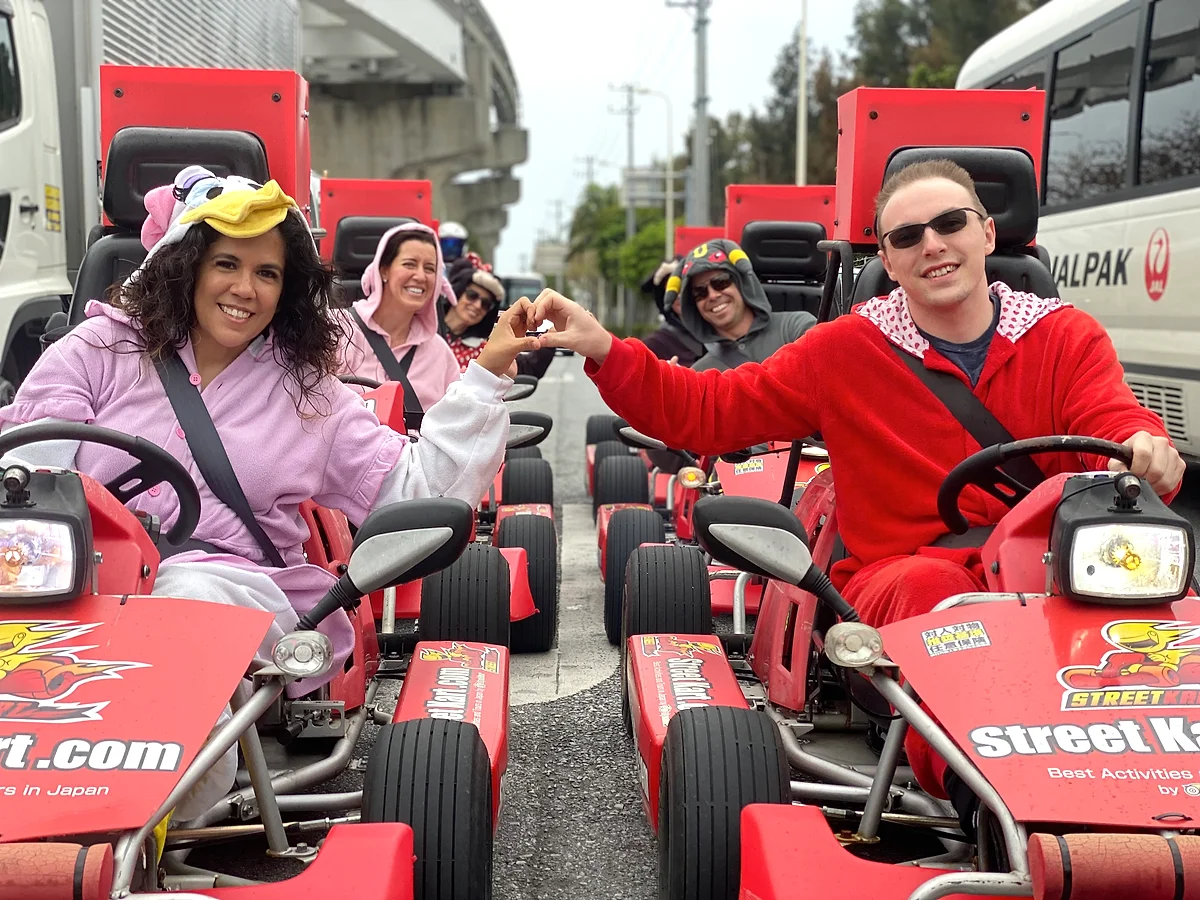
Along the course there are also stops for taking photos. Since you can't touch your phone while driving, take a photo of the two of you side by side when you stop. You'll have a picture of your karts lined up on the same street corner, on the day you reunited after all those years.
During this time, the two of you won't get to talk much. That's fine. The hardest part of a reunion is usually that first topic of conversation. After you've seen the same scenery in the same wind, the topics come on their own. "Did you see that bridge?" "That intersection made me a little nervous!" Talking about the drive you just finished comes out far more naturally than trying to fill in years of catching up.
Leave the Time After Your Drive Open
If you're cutting back on planning, don't pack the schedule after the tour either. When you finish, the engine noise is still ringing in your ears and you're both a bit wound up. The most natural thing is to ride that energy and drift over to somewhere nearby where you can walk and talk.
From the Shinagawa shop, Tennozu Isle, with art galleries and cafés along the canal, is a 20-minute walk. There are plenty of places to eat around Shinagawa Station, including atré Shinagawa, which connects directly to the station. You could also browse the local eateries on the Kita-Shinagawa shopping street, which still has an old-fashioned feel. Deciding where to eat as you walk is part of the fun.
In Akihabara, head to Kanda Myojin, a 10-minute walk away. This shrine has 1,300 years of history. A short way from the bustle of the Electric Town, you can talk in a calmer setting. If you want to go a bit further, Ueno Park, 5 minutes away by train, is another option.
In Shibuya, head to Meiji Jingu, a 20-minute walk away. Walking through the forest that spreads out in the middle of the city, you'll feel your excitement slowly settle. If you want a long talk over coffee, try the Omotesando area, 15 minutes away on foot. If you'd like to look out over the city from up high, SHIBUYA SKY, the observation deck at Shibuya Scramble Square a 10-minute walk away, is another option.
Shinkiba, home to the Tokyo Bay shop, is a bayside area surrounded by the sea and warehouses. After the tour, take a break at CASICA, a café and restaurant at Shinkiba Station, or head a little further out to Odaiba.
Plan Less and Focus on the Reunion Itself
The only planning you can't skip comes down to three things: booking, checking driver's licenses, and getting there by public transportation. Choosing a shop and a course takes care of almost everything else.
Weekends fill up fast, so once you've set a date, start by checking each shop's courses and booking contacts on the Street Kart official website.
After that first "It's been so long!" in years, you'll see the same sights together in the Tokyo wind. It doesn't matter at all if the words get stuck at first. By the time you finish your drive, you'll likely have more to talk about than you can fit in. Make it a wonderful reunion!
This article was originally written in Japanese and translated using AI. Some expressions may read unnaturally, and we appreciate your understanding. For the most accurate and up-to-date information, please refer to the official site at kart.st.
Street Kart is not affiliated with Nintendo or the Mario Kart series in any way. We do not provide costumes of Nintendo characters, and such costumes may not be worn during tours even if brought by participants.